The discussion around AI memory has changed noticeably over the last year. For a while, the central complaint was straightforward: assistants were capable and often surprisingly competent within a single session, yet they still lost context at exactly the points where continuity mattered most. They forgot stable preferences, long-running projects, relationship context, and the emotional texture around decisions that had already been explained once. The problem therefore moved from being a convenience issue to being a structural one, because repeated reintroduction sets a hard ceiling on what a system can understand about a person over time.
That ceiling is now being pushed upward. On June 4, 2026, OpenAI published Dreaming: Better memory for a more helpful ChatGPT, an update that describes memory less as a saved note feature and more as an active synthesis process operating across conversations. Anthropic has moved in a similar direction through Claude’s memory and chat search, through projects as semi-contained memory spaces, and, importantly, through memory import and export, which suggests that portability has already entered the product conversation in a concrete way. OpenAI’s own Memory FAQ and projects documentation point in a similar direction: memory is no longer peripheral, and product teams are beginning to define how memory should be synthesized, bounded, exposed, and reused.
Taken together, these developments suggest something larger than feature maturation. Memory is starting to behave like a systems layer in AI, and once a layer becomes strategic, the central question is no longer only whether it works or how exactly it works. The more interesting question concerns the architecture around it: where the layer lives, how it is represented, who can inspect it, how it is updated, and what happens when the user moves across products, providers, devices, and domains of life. And the most important one: who owns it?
Personal memory portability may matter much more than it currently appears, especially as current memory architectures become more capable and more deeply embedded in everyday software.
Memory Has Become An Architectural Layer
The recent provider updates are important because they move memory from workaround to architecture. In the first wave of assistant products, memory often meant pinned notes, manually saved facts, or retrieval over old conversations. The newer generation is more ambitious, but they still feel transitional rather than fully resolved. Memory is becoming synthesized, compositional, and entangled with action, which means that a system that remembers more can also schedule, recommend, coordinate, draft, and prioritize in ways that start to resemble a lightweight model of the person.
At the same time, the form of that memory remains tied to the product surface that produces it. OpenAI’s memory draws on chats, files, and connected apps while remaining only partly visible through a summary and partly embodied in a larger synthesized state. ChatGPT Projects organize memory around project containers. Claude follows a comparable path through memory summaries, project context, and bounded workspaces, and even its import/export capability still exports a provider-shaped memory object. These are useful systems, but they are still systems shaped by assistant workflows, project boundaries, and product assumptions. At a strategic level, they also reveal something else: the major providers are not only improving memory, they are competing to make their own ecosystems the default home of the user’s continuity.
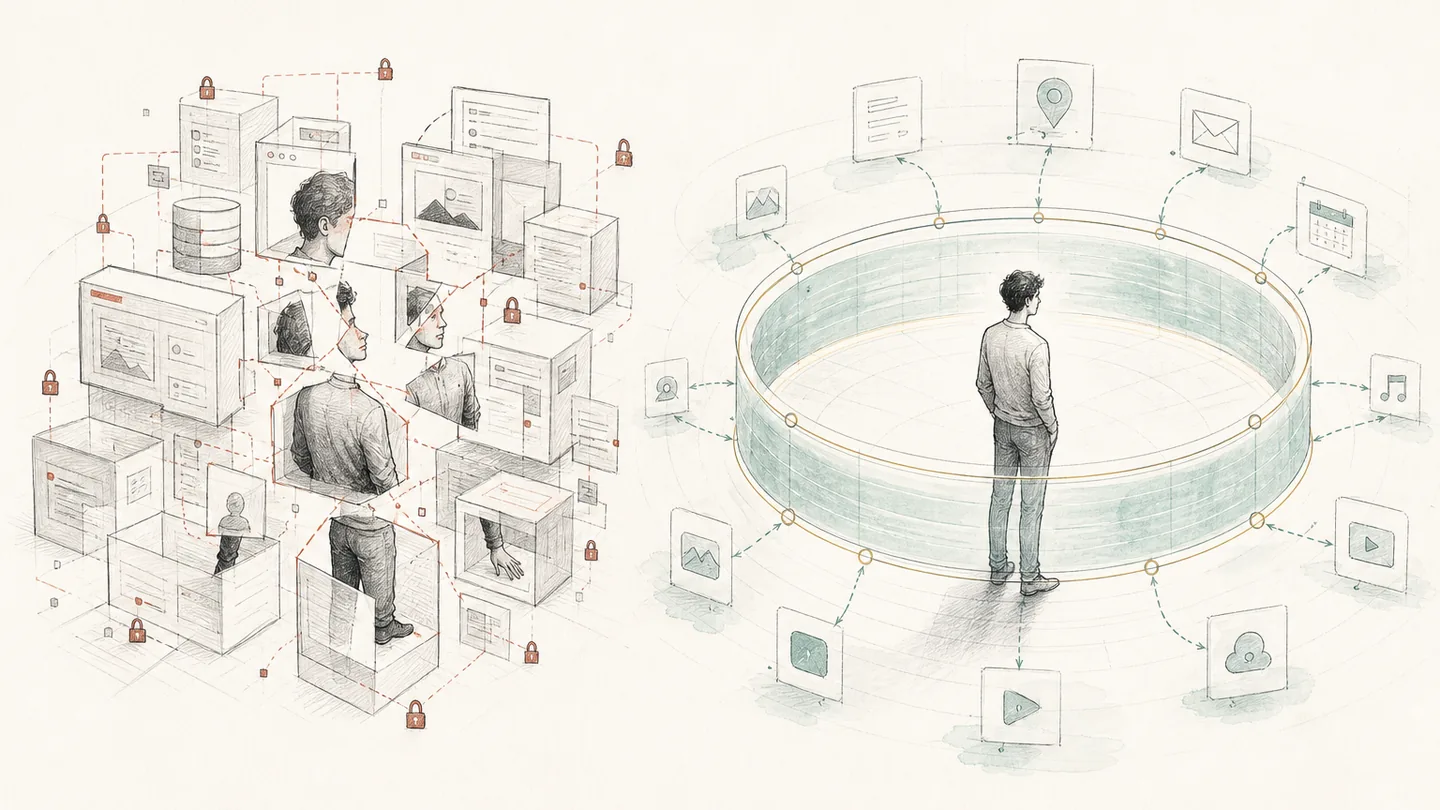
A likely version of that future is one in which each major provider offers its own increasingly capable, increasingly personalized assistant, while quietly turning memory into the deepest layer of ecosystem lock-in. For users, this would mean living across a set of intelligent but enclosed systems, each one knowing a different fragment of the self and each one incentivized to keep that continuity inside its own walls.
Portability Appears When One Person Uses Many Systems
This matters because a likely AI environment contains many models, many assistants, and many ordinary software products that happen to become memory-aware. A person may use one system for research, another for writing, another for scheduling, another for work communication, and another for software development, while expecting all of them to benefit from some of the same durable context: biography, constraints, goals, work history, relationship dynamics, and patterns of decision-making. If each product owns its own memory of the user, then each product constructs a partial self, producing unnecessary friction for the user. The result is duplicated personalization effort, growing switching costs, and a set of opaque models of the person that do not easily compose.
In that sense, memory is gradually becoming one of the clearest lock-in surfaces in the current AI economy.
Agent Memory And A Personality Layer Are Different Things
At this point it helps to distinguish two things that are often collapsed together: agent memory and a personality layer. Agent memory is operational and local. It includes recent turns, task state, tool traces, project instructions, temporary preferences, and whatever else an assistant needs in order to perform well in the current context. A personality layer is slower, broader, and more cross-contextual. One could also describe it as a personal metalayer: the deeper substrate that holds biography, stable preferences, style, values, recurring cognitive patterns, relationship context, and the longer continuity of a life. The two layers interact, but they do different jobs. An agent needs memory in order to work; a person needs a personality layer in order not to be repeatedly reassembled from fragments.
This distinction also clarifies the argument made in Why Building Personal AI Memory Like a Database Is Fundamentally Wrong. The central issue is not that storage or retrieval are unimportant. The issue is that a person cannot be reduced to a searchable pile of prior text. Human autobiographical continuity is temporal, selective, perspectival, and cross-domain. A biography is not the same thing as a relationship graph, a sequence of life events is not the same thing as a preference profile, and stable tendencies are not the same thing as episodic experiences. Once memory is treated as a model of a life rather than only as context retention, it becomes easier to see why a separate personality layer may need structure, evidence, timelines, permissions, and a disciplined way to represent uncertainty.
Such a personality metalayer matters not only because it stores more context, but because it does so in a form that is more compatible with how human cognition actually works: as a structured, evolving, and partly interpretive model of a life rather than as a flat archive of interactions. It functions as a proxy for the user in front of the rest of the digital world, carrying a coherent representation of identity across systems that would otherwise see only fragments.
The Proposed Solution Is A User-Owned Personality Layer
The proposal, then, is fairly concrete. Personal AI is likely to work better when the deeper layer of continuity is separated from any one assistant and treated as a user-owned memory and personality layer. By memory I mean the durable context of a life: biography, relationships, projects, constraints, important episodes, and evolving goals. By personality I mean style, tone, values, stable tendencies, recurrent cognitive patterns, and the ways a person tends to make decisions under different conditions. Together, these form something richer than a prompt profile and more durable than the memory of any single product.
This layer would not replace provider-side memory, products will still need their own working memory, caches, project containers, and task state. The separation matters at another level. The assistant keeps what it needs to execute well in the moment, while the person retains a deeper source of continuity that can be inspected, corrected, versioned, and selectively exposed across tools. In practice, this would mean that memory and personality become a substrate, or metalayer, that many applications can read from with permission, rather than an asset that each application fully recreates and encloses for itself.
The user’s own personality layer becomes part of the user’s digital property: a persistent asset they own, govern, and selectively expose through granular permissions to whichever services, agents, or model providers need limited access, while the underlying continuity remains under the user’s full control.
Its Applicability Becomes Clear Through Use Cases
The practical applicability becomes easier to see through examples. A work copilot could draw on professional history, current priorities, known collaborators, communication preferences, and decision style without inheriting intimate family context or private therapeutic material. A founder moving from one model provider to another would not need to retrain the new system on investor dynamics, product philosophy, or the interpersonal history of the core team, because those are properties of the user’s longer continuity layer rather than of the outgoing assistant.
A travel and scheduling agent could access recurring constraints such as preferred flight patterns, sensory dislikes, visa histories, children’s routines, family dietary boundaries, and the difference between business travel and restorative travel, while remaining blind to unrelated parts of the person’s life. A reflective or health-adjacent application could work with life events, emotional patterns, recurrent conflicts, and changes in self-understanding over time, while still leaving the canonical version of that inner history under user control rather than under product ownership. A tutoring system could adapt to motivational style, prior frustrations, and domains of confidence without rebuilding that understanding from zero every semester, while a family archive tool could preserve voice, chronology, and social context in a form that remains usable by future interfaces rather than frozen inside one discontinued app.
That shift seems worth taking seriously because it fits the direction in which the ecosystem is already moving. We are heading toward many agents, many providers, many narrow applications, and many surfaces through which AI acts. Under those conditions, a separate user-owned personality layer begins to look less like an ideological preference and more like a compact architectural solution. It offers a clearer source of truth, cleaner permission boundaries, and a more coherent way to let many systems act intelligently on behalf of one person whose life extends beyond any single product.
Seen this way, personal memory portability is less about exporting summaries from one chatbot and more about defining a new technical object: a user-owned personality layer, or personal metalayer, that represents the user across the digital world. If such a layer becomes real, providers would still differentiate through models, tools, interfaces, and execution quality, but the deepest stable representation of the person would remain with the user rather than with any single product.