The Consensus Nobody Is Questioning
Walk through any AI infrastructure conference in 2026 and you’ll see the same slide deck repeated with different logos. Vector databases. RAG pipelines. Graph stores. Entity registries. The pitch is always some version of: we solved memory for agents.
The hidden assumption underneath all of this is that any memory domain is basically a lookup problem. Get the indexing right, make semantic search good enough, and understanding will somehow follow. But the problem isn’t just scale, latency or model size. It’s that memory itself is being modelled in the wrong way, especially when the target is a specific human being and the goal is building personal intelligence.
Why Memory Systems Are Non-Negotiable
Any AI that wants to know and support a person needs memory. A stateless assistant that resets between sessions can’t coach you, track your growth, or notice that the pattern you’re describing today is the same one you described eight months ago in a different context. Without some real historical context, you don’t have a companion — you have a very smart stranger with amnesia, who needs to be reintroduced every morning.
The harder part is that human memory isn’t one thing. It’s a family of systems, each built for a different job. Working memory is the short-lived scratchpad that keeps a conversation coherent in the moment. Semantic memory holds general knowledge — facts about the world, how things work, who your colleague is, and what their title is. Episodic memory stores lived experience with time and feeling, which is why a person can remember an event rather than simply know it happened. Procedural memory stores patterns of action: how you decide under pressure, how you communicate when anxious, what you instinctively reach for when a problem feels familiar.
Most AI memory systems pick one of these and stretch it too far. The common approach — retrieval over a vector store — is basically a semantic memory system. It’s useful for storing and finding factual content by meaning. Other systems add relational structure or fast key-value lookups. By May 2026, more advanced setups were stacking these layers together: semantic memory in one store, recent interactions in another, behavioural preferences in a prompt template. But the core problem remained the same: the system still had no real way to unify those pieces into one coherent picture of a person over time.
And here’s the issue the field often says too softly: stacking silos next to each other doesn’t solve the problem, it just makes the fragmentation look more organized. In human memory, these systems are deeply connected. Episodic experiences gradually become semantic lessons. Emotion changes what gets stored and how strongly it sticks. Habits are shaped by repeated experience. A memory architecture that keeps facts in one bucket, events in another, and never really tracks why anything mattered is missing the thing that makes personal intelligence feel real.
What the Industry Actually Builds
There is a legitimate use case for general-purpose memory: enterprise knowledge management, coordination across organizational data, and search over large corpora. For those problems, the current stack works reasonably well.
Personal intelligence is a different problem. Understanding a specific human being — their history, fears, relationships, and the recurring themes of their life — requires something the general stack was never designed to handle. The next section lays out what that something is, in six structural arguments.
Six Reasons Human Memory Automation Must Be Domain-Specific
1. Memory Is Structured as a Life, Not as Records
The life-story model of identity argues that people build a coherent sense of self by turning their lives into narrative: chapters, turning points, commitments, reversals, and reinventions. Identity is not a static property you own; it is a story you keep telling and revising.
That matters for architecture. Biography is not the same thing as work history. Relationship dynamics are not the same thing as preference data. Psychometric patterns are not the same thing as social history. These are not arbitrary labels — they reflect different dimensions of a person’s life, and the connections between them matter just as much as the items themselves. General-purpose systems flatten all of this into a retrieval corpus and then pretend structure will emerge later. For a system that is supposed to understand a person, that is a foundational mistake. The structure of a life is not a layer you add at the end — it is the model you start from and it dictates the shape of every memory domain we have.
2. It Is Temporal by Design, Not by Configuration
Once you see memory as a life narrative rather than a flat store, time stops being optional metadata. You do not just remember that you changed careers — you remember the sequence of events that made the choice feel inevitable, what you were afraid of, and what happened before and after. The timing is part of the meaning.
General systems store timestamps, but they don’t treat sequence as structure. A career transition at 22 and the same transition at 45 may look similar in a database, even though they represent very different psychological events. A pattern that appears at 16 and then again at 35 is a meaningful developmental signal. Without temporal scaffolding built into the architecture, that signal stays buried. A filter can’t surface what the system was never built to recognize.
3. Memory Is Perspectival, Not Factual
This is the point that gets overlooked most often, and it may be the most important one.
Write on Medium
Human autobiographical memory does not store events like a security camera. It stores what you experienced. Two people can sit in the same conversation and walk away with different memories — different emotional weights, different details, different meanings. Both versions can be valid because memory is always first-person, always filtered through prior experience, current emotion, and the narrative identity someone is already carrying.
General-purpose memory systems are built for objective, reproducible storage. That makes sense for enterprise knowledge, but not for personal intelligence. An AI that stores only what happened, rather than what you experienced from your own POV, will eventually start describing you from the outside. It will know the facts and miss the person. In that context, treating memory as neutral record-keeping is not a harmless simplification, it is a category error.
4. Facts Are Emotion-Powered — Cross-Domain Associativity Is the Point
Human memory does not sort itself by data type. A smell can unlock a childhood scene. A song can bring back grief. These links are not accidental. They reflect how memory is actually encoded and recalled.
For personal AI, that creates a hard requirement. If a system keeps factual records in one place and emotional experiences in another, with no meaningful bridge between them, it reproduces the same fragmentation that makes many memory systems feel shallow. An AI that can connect a person’s current anxiety to a formative experience is doing something much closer to what a good therapist does. One that cannot is just a searchable journal with a chat window on top.
5. It Runs on “Use It or Lose It” — Not on Perfect Recall
Forgetting is not a bug in human memory. It is part of how memory stays useful. What gets reinforced stays available and becomes a connection point that links together all our smaller things; what is never revisited fades and loses significance. That is why memory remains calibrated to the present instead of treating every moment of a life as equally important.
General AI memory systems usually do the opposite. They accumulate everything with equal weight. The result is a kind of context rot: the system confidently resurfaces a trivial preference from three years ago with the same importance as something that changed last month. Some experiments that added forgetting curves to retrieval systems found that older, unreinforced information stopped polluting the pool and overall recall improved. A personal memory system needs to remember everything forever, but it also needs a soft forgetting and reinforcing mechanism that builds a valid representation of what still matters now. Without that, you are preserving a fossil, not modelling a living person.
6. Personal Memory Must Not Hallucinate — and Current Systems Do, Badly
Hallucination in a general assistant is annoying. Hallucination in a personal memory system is a disaster. If an AI invents a conversation you never had, misattributes a belief to you, or fabricates details about a relationship, it doesn’t just get the facts wrong — it damages the trust the whole system depends on.
Benchmarks that test adversarial robustness try to measure whether a model can admit it does not know something instead of inventing an answer. Many current systems perform badly on those tests, and some published results quietly avoid the hardest cases altogether. That is not a small oversight or compromise, in the name of improving benchmark score we lose the whole point.
The important architectural shift is simple: instead of guessing from dialogue, the system should extract structured facts about the person and retrieve those deterministically. If the fact exists, it can be returned. If it doesn’t, the system should say so. That is the standard a personal memory system needs. The bar for personal intelligence is <1% of hallucination, not “sound plausible”.
The Case for Neuroscience-Inspired Memory — Including Its Flaws
A fair objection comes up every time this design direction is proposed: human memory is unreliable, biased, and reconstructive, so why model an AI on it at all?
It’s a serious question. Human memory can be distorted, reshaped, and even misled. People can remember things that never happened. Retrieval can change the memory itself. By any strict standard, memory is imperfect.
But the case for neuroscience-inspired memory is not that human memory is flawless. It is that human memory is the architecture through which people build identity, meaning, and continuity. If you want an AI that understands a person, you need it to be compatible with the way that person actually organizes experience. That is not an endorsement of human error; it is a compatibility requirement.
A good analogy is a prosthetic limb. The goal is not to copy biology in every detail. The goal is to work with the way the body actually moves. A personal memory system that ignores temporal structure, emotional salience, and narrative coherence in favour of a cleaner data model may look elegant on paper, but it will fail at the point that matters most: when a person has to trust it with their actual life. We may think of a good memory system as a memory prosthetic that seamlessly connects to our own imperfect human memory on the one side and to the perfect purposed-build, agentic powered domain memory on the other side, creating a two-way personality bridge and granting us superpowers without friction.
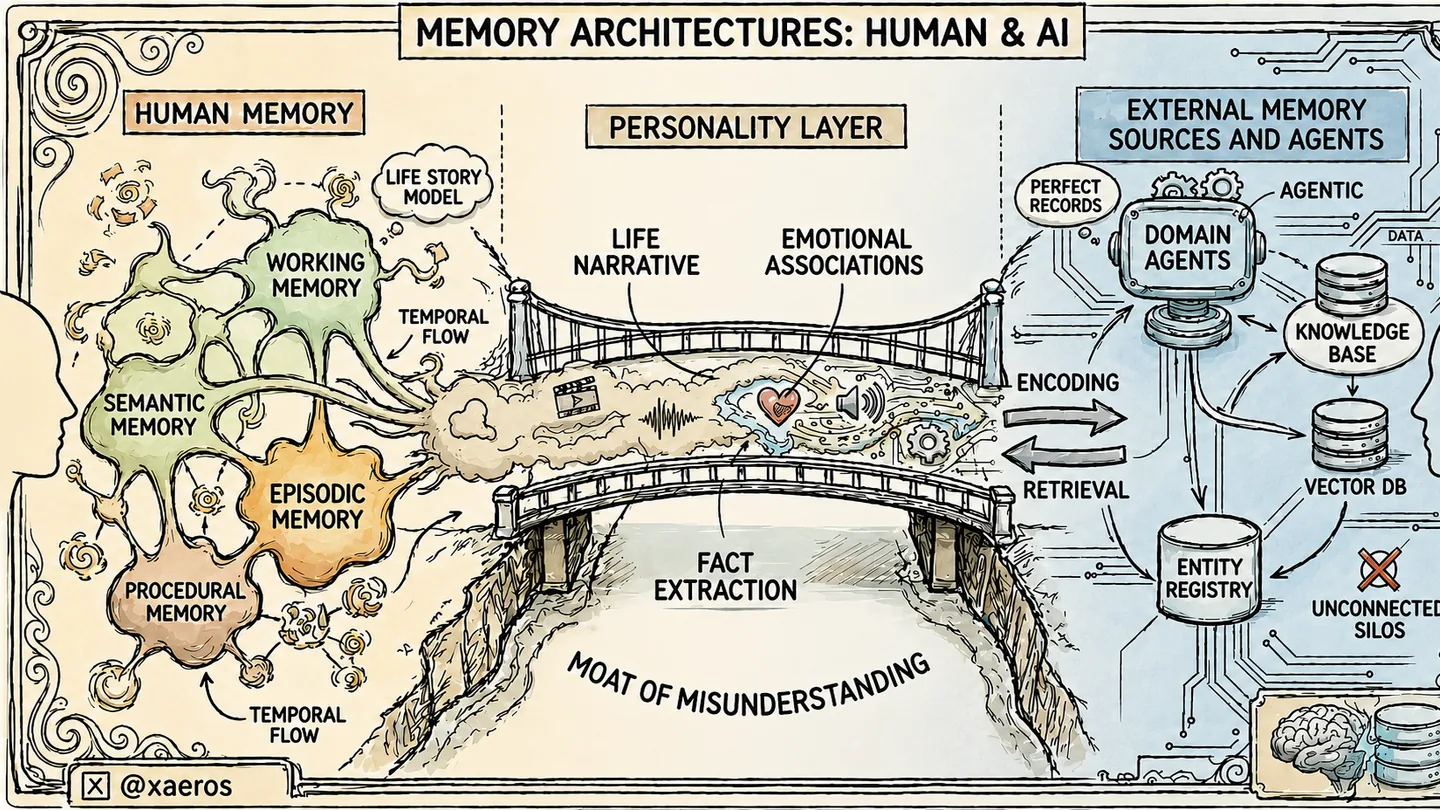
Understanding how memory works also makes it possible to improve it selectively. The aim is not to reproduce human memory’s weaknesses — suggestibility, drift, false recall — but to keep the principles that make it functional: emotional salience as a relevance signal, narrative structure as organization, and cross-domain association as the connective tissue of meaning.
What This Means Going Forward
Investment in AI memory infrastructure is huge, and most of it is going into better general retrieval. For enterprise use cases, that is probably fine.
For personal intelligence — for AI that actually knows a person, supports them over time, and gets better the longer it is used — that direction is not enough. It is the wrong starting point. The constraints outlined here — temporal structure, salience-weighted forgetting, emotional cross-links, life-shaped architecture, and zero tolerance for hallucination — are not optional features. They are the design requirements. This is now overlooked by the whole industry — starting from individual developer teams and ending with VCs in search of the next unicorn.
The next generation of personal AI will not be won by whoever stores the most data and gets it back faster. It will be won by whoever builds the right kind of compatible human memory.