
I have spent enough time moving between AI products to know the ritual. A new tool opens with almost no understanding of me, and during the first few days I explain how I write, what I am working on, which constraints matter, and which kinds of answers waste my time. If I stay, the product gradually assembles a serviceable sketch. Then I open another product and begin again.
Earlier digital personalization usually meant feed ranking, product recommendations, or a few interface defaults, so the consequences of fragmentation stayed near the surface. AI can reach much further into the relationship between a person and a product. It can adapt language, timing, planning, coordination, recommendations, and the interpretation of the user’s situation. The expense of creating that understanding now sets a practical limit: every product must collect enough context, every team must build machinery to interpret it, and every user must teach another system how to be useful.
I have started using Bring Your Own Human, or BYOH, for the architecture I have in mind. A person enters an application with a user-owned continuity layer already in place. The application can understand the relevant part of that person from the beginning, learn more within its own domain, and return useful updates to the same layer under the user’s control. BYOH names an infrastructure model for personalization that accumulates across products instead of restarting inside each one.
Personalization Still Starts Too Late
Most personalization today begins too late and with too little. A system meets the user as a near-stranger, then infers a person from whatever local traces are available: a few conversations, a project folder, a purchase history, saved preferences, perhaps a calendar or a drive. The result can be useful, though it usually remains delayed and narrow. The system learns the person through the small opening created by its own product.
Users pay for that limitation through repetition. We restate preferences, re-explain projects, and describe the same family constraints, travel habits, working style, and tone to one tool after another. After all of that, a product may adjust its tone or recommendations while its understanding of the person remains partial and easily lost.
Application teams pay as well. Any product that wants serious personalization must assemble onboarding questions, preference capture, behavioral signals, memory summaries, relevance heuristics, update logic, storage, and security. It then has to infer a relatively broad human from a very narrow slice of activity. Much of this work is duplicated across companies, including those whose real expertise lies in travel, education, finance, writing, or another domain far removed from modelling personality.
This problem also belongs to an older discussion about ownership and the web. Long before current assistants, parts of the open-web world were already asking whether people should have to surrender their data to each service in order to participate online. The Solid project argues for personal data stores decoupled from applications. The MyData Declaration frames personal data empowerment as a question of agency and self-determination. GDPR Article 20 gave data portability legal form in Europe, and the Data Transfer Initiative grew out of the more practical problem of moving user content between platforms. These efforts differ in scope, but they share an intuition that feels newly important in AI: information about a person should not be trapped inside the application that happened to collect it first.
AI sharpens that old concern. The object being accumulated now includes an operational model of the person, capable of influencing how software interprets requests and acts on the user’s behalf. Rebuilding that model inside every application is becoming expensive for users and developers, while enclosing it inside each product makes the resulting continuity difficult to combine or govern.
Bring Your Own Human
In BYOH, the user arrives with a persistent human proxy connected to a deeper layer of personal continuity. The proxy is the user’s outward-facing representative in the digital world. It carries context in a form software can use, changes as the person changes, and reveals relevant parts of that context through permissions set by the user.
The application keeps its own local memory. A travel planner still needs the current itinerary, a coding agent needs repository state, and a work assistant needs the immediate history of a project. Those are short-horizon materials tied to a task and a product. The human proxy supplies continuity that already existed before the task began: relevant habits, constraints, preferences, relationships, and patterns that would otherwise take weeks or months to infer.
BYOH also gives learned context a route back to the user. A product may discover something durable while doing the job it knows well. A travel service may learn that a user’s apparent preference for morning flights disappears when travelling with children. A writing tool may observe that a requested tone changes with the audience. With provenance and user review, these observations can return to the continuity layer instead of remaining trapped as private product knowledge.
In this arrangement, personalization becomes shared work. Each application contributes from the domain it understands and begins with context contributed elsewhere. The user repeats less of their biography to software, and products can apply their own expertise before they have spent months reconstructing the person.
The Human Proxy And The Personality Layer
BYOH grows from two earlier arguments. In In Defense of Personal Memory Portability, I examined memory as a growing source of lock-in. In Why Building Personal AI Memory Like a Database Is Fundamentally Wrong, I looked at the internal structure personal memory requires. Together they leave a practical question: how can a rich, user-owned model of continuity become useful inside many different products? BYOH is my answer at that boundary.
The human proxy faces outward, while behind it sits the personality layer: a deeper substrate containing biography, stable preferences, values, style, relationship context, recurring goals, patterns of thought, and the longer narrative continuity of a life. Architecturally, it functions as a personal metalayer that develops more slowly than product memory and gives many systems a coherent way to encounter the same person across different contexts.
The ancient Egyptian multipart conception of the soul offers a useful metaphor. The Ba, often represented as a human-headed bird, was one mobile aspect of the individual that could move into the world while remaining connected to the life behind it. A human proxy has a comparable role: it can travel across digital settings and represent the person there while its deeper continuity remains under the person’s control.
Agent memory serves another purpose. It holds recent turns, tool traces, instructions, temporary constraints, and project state so that an agent can continue the current job. The personality layer carries continuity across jobs, interfaces, and domains. This distinction tends to disappear when both are treated as retrieval. A good index can recover prior material, but autobiographical continuity also depends on sequence, salience, uncertainty, reinterpretation, and changes in meaning over time.
A faithful human proxy needs a personality layer that preserves this wider structure of a life.
Ownership, Delegation, And Portability
The same memory that improves a product also becomes a retention mechanism. The incentive is straightforward: a service becomes more useful as it learns the user, and leaving becomes more costly as that understanding deepens. Large providers naturally want their ecosystems to become the default home of this continuity.
At the application level, this produces a great deal of duplicated work. A travel product maintains one private miniature of the user, a writing tool another, and a work system a third. Each service collects signals, resolves contradictions, updates profiles, secures sensitive context, and stores it over time. Around the user grows a collection of disconnected representations that are difficult to inspect or combine. BYOH offers an entry point closer to Log in with your digital person: a new application receives relevant, permissioned continuity at the beginning of the relationship and can direct its resources toward the domain it was built to understand.
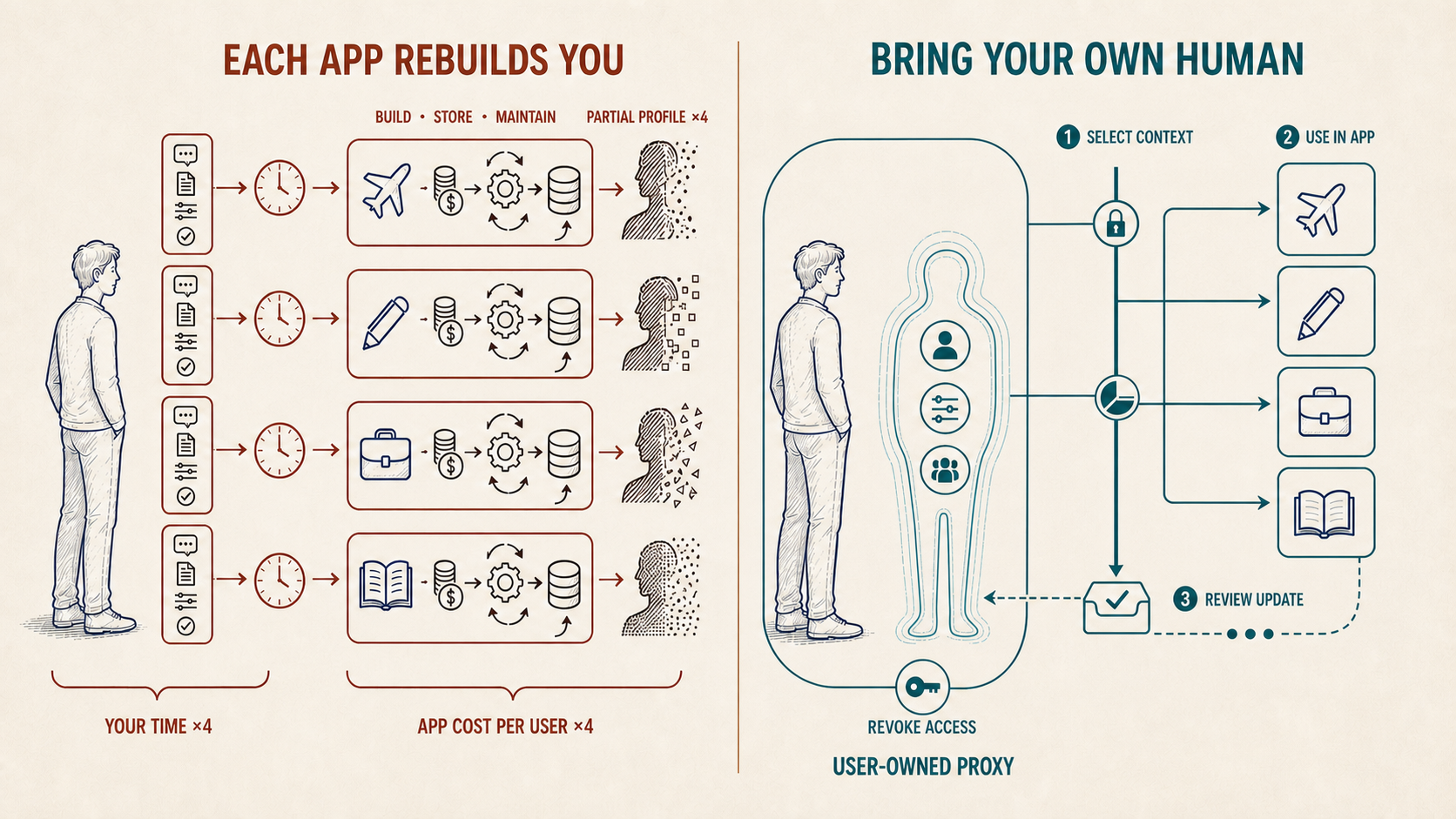
The personality layer belongs to the user as part of their digital property. The human proxy exposes selected parts of it through permissions scoped by subject, purpose, and duration. A work tool may receive professional history, meeting habits, and communication style. A travel service may receive route preferences and family constraints. A tutoring system may receive learning history, prior frustrations, and motivational patterns. Each sees a useful part of the person, and the user can inspect, correct, or revoke that access.
Portability supports this arrangement, though moving a summary or JSON archive between providers goes only part of the way. BYOH depends on an active, permissioned connection to a user-owned layer, granular delegation, and updates that can return to the layer with clear provenance. The personality layer supplies the durable source of continuity; the proxy makes that continuity usable at the application boundary.
What This Changes In Practice
Travel offers a concrete example. A booking service may learn over several years that I choose quiet hotels, walkable neighborhoods, late check-in options, and rooms with a reliable desk because I often work after arrival. My travel history and reviews may also show that I avoid red-eye flights before important meetings, travel differently with family, and accept a longer route when it reduces friction on the ground. With permission, those observations could help a flight search tool choose the next itinerary, a calendar agent set a realistic arrival buffer, and a mapping service compare hotels against meeting locations. The continuity stays with the user while each product applies it to a different decision.
The same pattern extends into work and learning. A writing environment may learn that I develop an argument by establishing the conceptual stakes before moving into mechanisms and examples. A presentation tool or research system can use that knowledge immediately. A learning platform may discover that historical framing helps me stay engaged with an abstract topic, and a tutor in another subject can begin from that understanding. Each product adds a small piece from direct experience, and the personality layer holds the connections between them.
Making this work requires more than a shared profile format. Applications need a common language for permission scope, provenance, freshness, confidence, and authority to propose updates. Revoked permissions must close future reads and writes, conflicting inferences must remain inspectable, and sensitive domains need clear boundaries. These requirements place BYOH at the infrastructure level, underneath the onboarding surface where a user first encounters it.
Under BYOH, one person has one user-owned personality layer. Applications receive narrow, revocable views of it and contribute reviewed knowledge from the domains they understand. Over time, a travel service, writing tool, work agent, and tutor can help build a more complete digital person while each participant sees only its permitted part. That is the practical proposition behind Bring Your Own Human: software can meet the same person across contexts, and the continuity those products build together remains with the human who owns it.