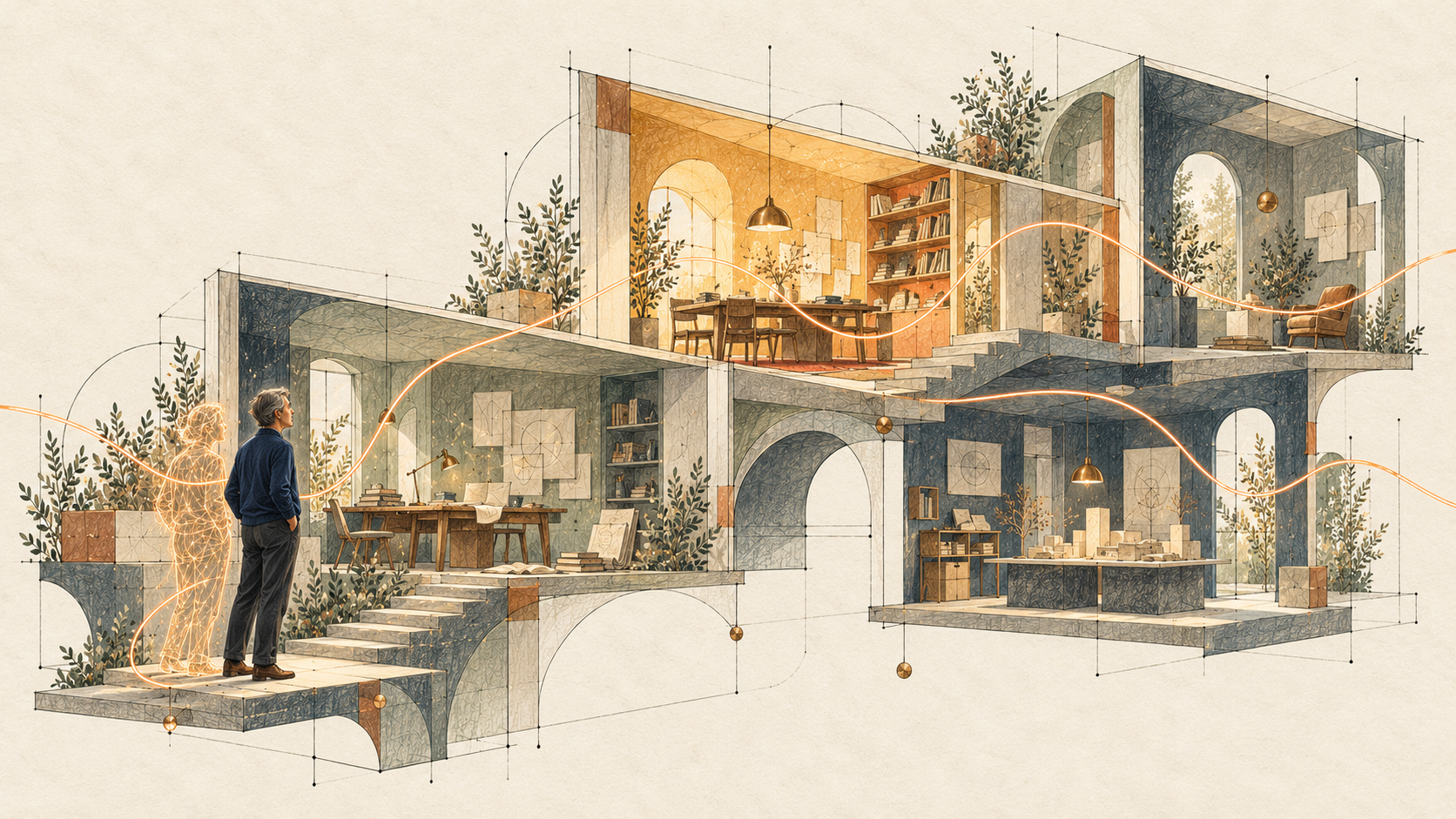
A conversation can change direction while the people in it remain much the same. We may spend half an hour thinking through a difficult decision, turn to a practical arrangement, and return later to the unfinished thought. What makes that return work is a shared understanding of where we stopped: the possibility we had ruled out, the reservation still unresolved, the reason a particular detail mattered.
In Synthius, the starting point is an indefinitely continuing conversation with the same person. In this sense, an infinite conversation has no predetermined endpoint: new concerns enter it, earlier ones return, and its history keeps developing alongside the user’s life. Focus implements the working structure for that continuity as part of a wider design for making personal AI compatible with humans. Keeping a transcript provides a record of the exchanges; continuing them coherently also requires a way to preserve their separate purposes and decide which one should guide the next response.
One continuous chat contains several resumable working states, each with its own history and summary, while a shared personality layer carries durable knowledge of the user across them. Focus works alongside structured personal memory, evidence tracking, and controlled retrieval. Research on attention and memory helps explain the human requirements behind that arrangement: information can remain available while something else takes priority, and experience can change our wider understanding without remaining continuously in view.
A Thread Has a Purpose
The subject of a conversation tells us only part of what is happening. We might begin by organising a review for a current work project. An upcoming visit to our parents comes into the conversation, and we start remembering earlier visits or reflecting on why we have kept postponing this one. A little later, we ask for help finding tickets. The journey connects these exchanges, although the kind of help we need changes along the way.
An assistant can retain every relevant fact and still respond awkwardly if it carries the wrong conversational purpose forward. While reflecting on the family visit, we may want it to draw on personal memories and relationship history. When comparing departures, we need dates, routes, and practical constraints. Continuity includes an understanding of what we were doing together, how far we had got, and what remained open.
In Synthius, a Focus binds that purpose to a retained working state. Each definition has a name, a short description of when it fits, and fuller instructions governing its approach. Synthius provides a prepared set, including Your Synthius for practical assistance and Chat as Yourself for personal conversation in the selected persona’s voice. Users can select an existing Focus or add a new one suited to a recurring concern. The set can develop as the relationship develops, with its size following the person’s needs.
The structure accommodates several ways of creating a Focus. A person can define the approach they need directly, or an agent can formulate a new Focus as it learns about their goals, habits, and recurring situations. Repeated discussions about a business, a creative project, or a particular kind of decision can supply the basis for a specialised purpose and instructions. Creation establishes that reusable definition; subsequent exchanges give it a conversational history that can be resumed. Choosing a Focus for the next reply and developing a new one are distinct operations within the same architecture.
Before answering, the agent uses those descriptions and the immediate conversational purpose to decide whether to stay or switch. In this example, the available set contains three distinct Focuses: a work Focus for the project, a personal Focus for family memories and reflection, and a travel Focus for the journey and ticket booking. Each preserves its own progress and approach. Explicit selection takes priority. Ambiguous follow-ups and incidental changes of subject stay in the current Focus, and a recent manual choice receives particular weight. When a switch is justified, the agent calls a switching tool before replying or acting; the runtime validates availability and restores the destination state. Automatic switching is limited to once per turn.
The resulting continuity follows what the person is trying to do. A new subject can remain within the same Focus, while the same subject can call for another approach when the purpose changes. Returning to an earlier purpose recovers the unfinished work that gave the conversation its meaning.
Returning Means Restoring
The architecture begins with one chronological transcript. Messages retain their identifiers, timestamps, and Focus attribution, so the sequence of events remains available even as working context changes. Each Focus also maintains a rolling summary and recent turns that have yet to be folded into it. These provide a compact account of where that particular conversation stands.
Suppose I am preparing a review for a current project when I mention an upcoming visit to my parents. The conversation moves from the work Focus into the personal Focus as we recall earlier visits, draw on memories of time spent together, and explore why I have been putting this journey off. When I ask to find tickets, the travel Focus takes over with its own instructions and working state. After comparing routes and departure times, I say, “I’d like to come back to what I said about visiting my parents.”
The personal Focus restores the unfinished family conversation, including the memories and unresolved thought that gave it meaning. The system selects that Focus’s history before applying recency within it. Reversing those operations can discard the relevant exchange before the system identifies what belongs to it. A recent global window may be full of ticket options and dates while the family conversation has already fallen outside it.
On that return, the next model input combines the travel Focus’s summary and recent turns, a record of the transition, the restored personal Focus state, and the new message, included once. Relevant personal grounding and the selected Focus’s instructions accompany that context. The work Focus remains preserved and accessible through history recall, alongside any other inactive Focuses, without occupying the entire working input on every response.
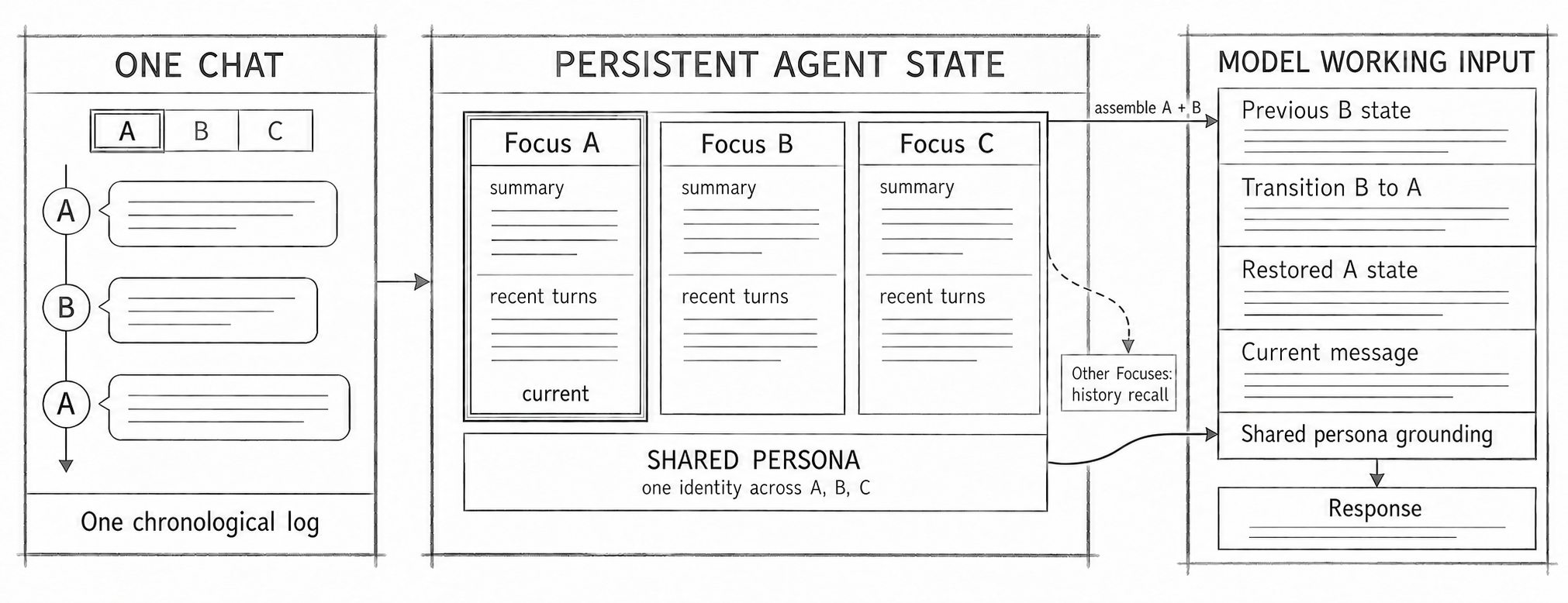
An indefinitely continuing conversation still uses a finite working input for each response. A preserved Focus can contain far more history than belongs in the next model call, so restoration combines its summary, recent turns, and further recall when needed. Keeping the original chronology gives the assistant a route back to details that compaction omitted. The conversation can keep developing while its immediate working context remains bounded.
Including the transition preserves what happened between leaving and returning. The departure time chosen in the travel Focus might leave an extra evening with the family, which becomes relevant to the reflection. The work Focus can later restore the project review, with the travel Focus’s history supplying departure details when needed to organise the remaining work. Focuses interact through this transition, shared personal memory, and explicit recall of other histories. Their working summaries remain separate, preserving the circumstances and purpose of each exchange.
What Stays Outside Attention
Working-memory research offers a useful distinction between information currently guiding behaviour and information retained for possible later use. In Rose and colleagues’ 2016 experiments, neural decoding of an unattended memory item dropped towards baseline after attention shifted. A pulse of transcranial magnetic stimulation briefly recovered a decodable signature when the information remained potentially relevant. The findings support a distinction between attended and latent states within the task.
Retained information can therefore have different degrees of immediate availability. Focus gives software an explicit version of that distinction. One state guides the current exchange, others remain recoverable, and a later cue can restore an earlier state. The experimental findings concern brief retention under controlled conditions; a stored software state can survive much longer and uses entirely different mechanisms. The correspondence lies in selective availability and reactivation.
A second connection concerns control over updating. O’Reilly and Frank’s computational work on the prefrontal cortex and basal ganglia models a gating mechanism that regulates which task-relevant information enters working memory. A Focus controller faces a related engineering problem: deciding when new material should continue the current purpose and when another preserved state should become active. In Synthius that decision occurs before the response, at the level that assembles model input. It is separate from the transformer’s internal attention calculations.
There is also a connection with how experience acquires boundaries. Baldassano and colleagues found stable patterns associated with narrative events, transitions between them, and reinstatement during later recall. Their findings suggest a way to think about conversational history as meaningful episodes within a continuous stream. Focus makes an explicit software decision about those boundaries and allows an unfinished purpose to be resumed. The papers help motivate this design; its particular categories and transition rules remain engineering choices.
Together, these connections suggest an assistant that preserves context at several levels of availability. It can attend selectively while maintaining routes back to material that belongs to an earlier purpose. That is a more useful standard for continuity than assuming all retained information must remain equally active.
Two Kinds of Memory Work
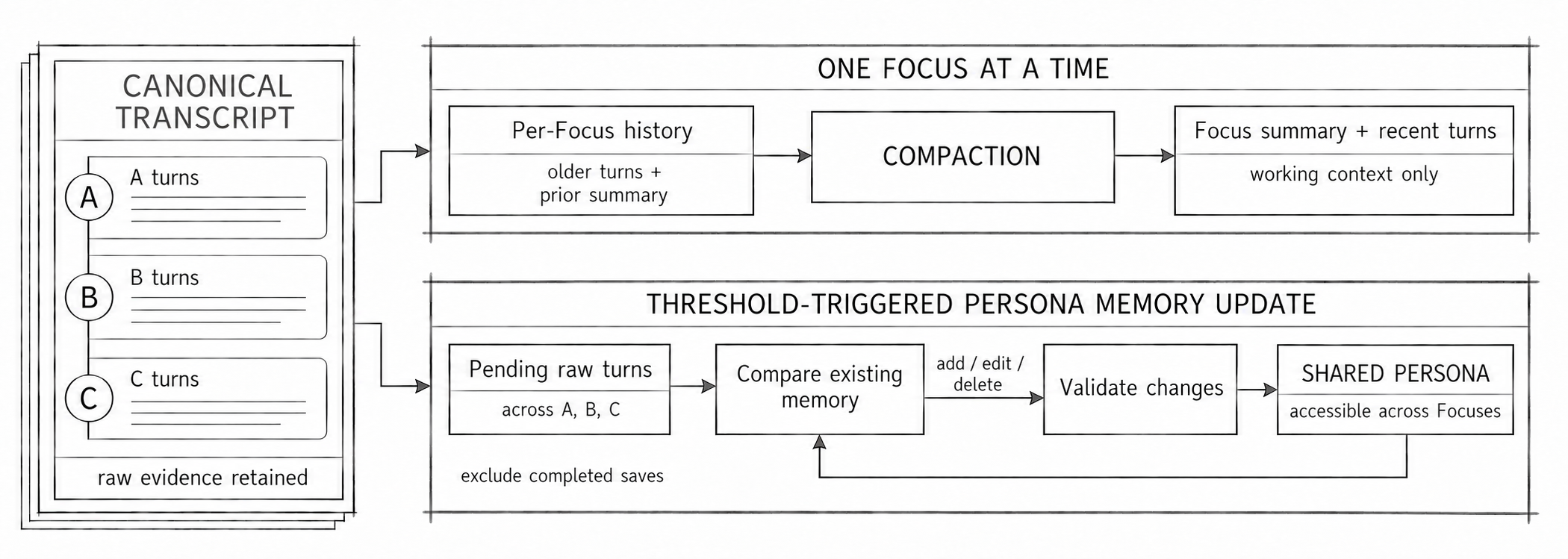
Maintaining a Focus over time requires compaction. Older messages are merged with that Focus’s existing summary while recent turns remain directly available. A useful summary preserves open questions, commitments, decisions, and interaction signals. Each Focus is maintained separately, and the original transcript stays intact. The summary serves the next stage of the conversation within a limited input budget.
Learning something durable about the user follows a separate path. When accumulated conversation reaches the memory-saving threshold, a background process examines original messages across Focuses, compares the evidence with existing personal memory, and applies validated changes. Receipts track which messages have already been processed, helping prevent the same source material from being treated repeatedly as new evidence. The updated personality layer remains accessible in every Focus, with relevant information retrieved under the existing permissions.
Returning to original messages matters because a summary already contains interpretation. If an uncertain inference enters one summary and then becomes the evidence for another, the system can gradually make its own earlier wording look authoritative. Separate memory updating provides a place to check proposed changes against what the user actually said, including the circumstances and any later correction.
Keeping those processes separate protects an important difference in meaning. “I keep putting off visiting my parents” may describe a difficult period at work, a concern about the relationship, or several circumstances together. The family reflection and the later booking discussion supply different evidence about what the remark means. The personality layer needs to preserve that context as its understanding develops. The architecture provides access to the original messages; the quality of the result still depends on how validation handles uncertainty, contradictions, and correction.
There is a broad parallel with complementary learning systems theory, which describes different roles for rapid acquisition of experience and the gradual integration of structured knowledge. In Focus, working summaries help preserve the immediate exchange, while personal memory accumulates an account of the user across exchanges. A token threshold schedules a software operation; biological consolidation follows its own processes and timescales. The useful architectural lesson concerns learning at different levels without forcing every conversation into one permanent interpretation.
This develops the personality-layer argument from the memory essay. Biography, relationships, preferences, and recurring patterns need structure that survives a change of task. That personal metalayer can inform many Focuses while their local histories retain the circumstances in which particular thoughts arose. The assistant can adapt to the present exchange and continue revising its wider understanding of the person.
The Same Person Across Contexts
Focus supports an indefinitely continuing discussion in which concerns emerge, interrupt one another, and return as circumstances change. Work on a project, reflection on family life, and arrangements for a journey can share one conversation while retaining three distinct Focus states. Earlier visits may become relevant months later, while the work itself continues through other concerns. A recent-message window can lose an earlier thread. A global summary has to compress several purposes together. Separate chats preserve local histories but leave the person to choose a thread and carry relevant changes between them. Retrieval can find a useful passage, while resuming a purpose also requires its unresolved questions, decisions, and working state. Focus combines that state restoration with recall and shared personal memory.
The same mechanism can support professional work. An investment-analysis Focus can centre on assumptions, valuation, and diligence, while a development Focus can guide architecture, implementation, and debugging. These can come from the prepared set, be added by the user, or be formulated by an agent that has learned how the person works. Each retains its own conversational history and instructs the agent to search for relevant material within the sources already authorised for the chat. A switch restores the appropriate working state and approach. Focus instructions guide the choice of queries and use of evidence, while document collections and access remain configured independently for the chat.
The main expected gain is less work for the user when resuming an interrupted concern, together with less interference from unrelated conversation. Task accuracy may benefit when the restored context preserves a constraint that would otherwise disappear, but the design supplies no general accuracy guarantee. Token savings also depend on the workload: selective context can avoid replaying everything, while supplying both the previous and selected states, switching, and compaction add costs. The routing instruction runs within the normal agent workflow, with its model usage included in the same accounting. A useful comparison measures resumption quality, user corrections, tokens, and latency with the same model and budget.
The Bring Your Own Human article describes the personality layer’s role across applications. Focus organises attention within a conversation that draws on that layer. Permissions, tools, and model policy remain independently enforced as purpose changes. These mechanisms work together in Synthius to let personal understanding persist while the immediate exchange takes a different direction.
Synthius implements Focus alongside its personality layer, structured personal memory, and retrieval from original evidence. The conversation can continue indefinitely as a person leaves a thought unfinished, deals with another part of life, and returns to its earlier reasoning and open commitments. Its set of Focuses can evolve with the person’s concerns, while knowledge accumulated across exchanges remains available to the same continuing relationship. This is a practical expression of compatibility between AI and humans: the software preserves enough structure for a person’s changing purposes to coexist with a coherent history.